
Ürünler


Pnomatik Sistemlerde Güvenlik Eğitim Seti
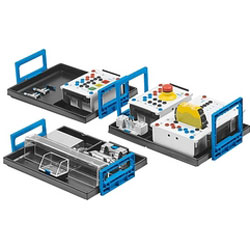
Risk reduction!
Just like good functionality and economic efficiency, safety is essential to the success of any product. What is more, new directives and laws require intelligent solutions and raise the level of professional skills required. As a result, there is a wide range of different products, information and qualifications for safety engineering. However, most of these focus on the control level, meaning that safety usually only goes as far as the output of a fail-safe PLC, for example. Risks can also arise outside of the power section, however, so it is important that systems include risk reduction measures to cope with such problems.
Just like good functionality and economic efficiency, safety is essential to the success of any product. What is more, new directives and laws require intelligent solutions and raise the level of professional skills required. As a result, there is a wide range of different products, information and qualifications for safety engineering. However, most of these focus on the control level, meaning that safety usually only goes as far as the output of a fail-safe PLC, for example. Risks can also arise outside of the power section, however, so it is important that systems include risk reduction measures to cope with such problems.
But what does the "pneumatics specialist" entrusted with the commissioning, troubleshooting, set-up, maintenance and simple optimisation of a system need to know? And how can this knowledge be conveyed in a clear manner, with easy-to-follow steps?
TP 250!
TP 250 builds on the training content of TP 101 and TP 201, focusing on the systematic optimisation of safety in pneumatic systems. The aim of the training package is to detect risks in pneumatic processes, to assess the risks for a simple "machine" and to learn what measures can be used to reduce risks and how to implement them properly.
Training content
•Reducing pressure and force according to the work to be performed
•Reducing the speed and acceleration while observing the cycle time and the flow control for the specific loading conditions
•Emergency stop and release: suitable measures for stopping and properly recommissioning a pneumatic drive
•Suitable measures in case of compressed air failure and return, as well as instructions on how to store and use auxiliary energy
•Suitable measures in case of power failure and return
•Getting to know the operating modes and signals for operating statuses
•Using sensors to detect malfunctions
•Increasing the performance level using a dual-channel emergency stop system
•Selecting and using suitable protective measures
Components from equipment sets TP 101 and TP 201 are required to carry out the projects. Mounting the pneumatic system, consisting of cylinders, weight and cover, is done on the profile column of a Learnline workstation. If there is no profile column available, the mounting kit for Learntop S (order no. 526847) or the mounting kit for vertical slotted profile plates (order no. 533528) can be used. Two of each of these are needed.
Also order:
Workbook
The workbook contains project tasks of progressive difficulty level, together with the solutions for each exercise sheet. In these exercises, students reduce the potential risk level of a pneumatic system step by step. The basic level contains the following topics: overview of relevant standards, laws and regulations; overview and detailed description of operating modes; overview and detailed description of ten relevant safety functions; possible technical solutions for each safety function; extensive illustrations and cross-sections to explain the design principles.
The workbook contains:
•Sample solutions
•Training notes
•Multimedia CD ROM with graphics and photos of industrial applications, safety guidelines, safety poster
•Worksheets for students
Supplementary media
•Training program in digital safety engineering
•Training program in digital pneumatics/electropneumatics
•Designing and simulating with FluidSIM®
•Measuring and controlling with FluidLab®
•Pneumatics/electropneumatics textbook
•Set of posters on pneumatics
Recommended accessories
•Alüminyum profil plaka
•Kompresör
•Masaüstü güç kaynağı birimi
•Montaj çerçevesi için güç kaynağı birimi
•4 mm Safety laboratory cables, 106 pieces, red, blue and black
•Safety in pneumatic systems TP 250: Workbook
The most important components at a glance
•Air pressure reservoir, 0.1 l
•Çek valf, açılabilir
•5/3-way solenoid valve, mid position closed
•Non-return valve
•Weight, 2 kg, for cylinder
•Cover for cylinder
•Operational status display
•Mushroom-head safety switch
•Safety relay for emergency stop and safety door
TP 250!
TP 250 builds on the training content of TP 101 and TP 201, focusing on the systematic optimisation of safety in pneumatic systems. The aim of the training package is to detect risks in pneumatic processes, to assess the risks for a simple "machine" and to learn what measures can be used to reduce risks and how to implement them properly.
Training content
•Reducing pressure and force according to the work to be performed
•Reducing the speed and acceleration while observing the cycle time and the flow control for the specific loading conditions
•Emergency stop and release: suitable measures for stopping and properly recommissioning a pneumatic drive
•Suitable measures in case of compressed air failure and return, as well as instructions on how to store and use auxiliary energy
•Suitable measures in case of power failure and return
•Getting to know the operating modes and signals for operating statuses
•Using sensors to detect malfunctions
•Increasing the performance level using a dual-channel emergency stop system
•Selecting and using suitable protective measures
Components from equipment sets TP 101 and TP 201 are required to carry out the projects. Mounting the pneumatic system, consisting of cylinders, weight and cover, is done on the profile column of a Learnline workstation. If there is no profile column available, the mounting kit for Learntop S (order no. 526847) or the mounting kit for vertical slotted profile plates (order no. 533528) can be used. Two of each of these are needed.
Also order:
Workbook
The workbook contains project tasks of progressive difficulty level, together with the solutions for each exercise sheet. In these exercises, students reduce the potential risk level of a pneumatic system step by step. The basic level contains the following topics: overview of relevant standards, laws and regulations; overview and detailed description of operating modes; overview and detailed description of ten relevant safety functions; possible technical solutions for each safety function; extensive illustrations and cross-sections to explain the design principles.
The workbook contains:
•Sample solutions
•Training notes
•Multimedia CD ROM with graphics and photos of industrial applications, safety guidelines, safety poster
•Worksheets for students
Supplementary media
•Training program in digital safety engineering
•Training program in digital pneumatics/electropneumatics
•Designing and simulating with FluidSIM®
•Measuring and controlling with FluidLab®
•Pneumatics/electropneumatics textbook
•Set of posters on pneumatics
Recommended accessories
•Alüminyum profil plaka
•Kompresör
•Masaüstü güç kaynağı birimi
•Montaj çerçevesi için güç kaynağı birimi
•4 mm Safety laboratory cables, 106 pieces, red, blue and black
•Safety in pneumatic systems TP 250: Workbook
The most important components at a glance
•Air pressure reservoir, 0.1 l
•Çek valf, açılabilir
•5/3-way solenoid valve, mid position closed
•Non-return valve
•Weight, 2 kg, for cylinder
•Cover for cylinder
•Operational status display
•Mushroom-head safety switch
•Safety relay for emergency stop and safety door