
Ürünler


Mikroişlemci Eğitim Seti
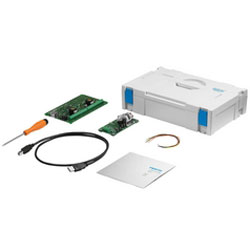
Embedded systems made easy
Until now, the development of embedded systems has been the preserve of specialists. Every step of the design process, the manufacture of special printed circuit boards and the programming of the microcontroller (usually only in C++ or Assembler) required expert knowledge and instruction. This is where the idea of EasyKit comes in: standardised, easy-to-batch electronic modules and a graphically orientated programming interface make it much simpler to create microcontroller-based control systems. This means that sophisticated applications can be created with a minimum amount of integration work.
Until now, the development of embedded systems has been the preserve of specialists. Every step of the design process, the manufacture of special printed circuit boards and the programming of the microcontroller (usually only in C++ or Assembler) required expert knowledge and instruction. This is where the idea of EasyKit comes in: standardised, easy-to-batch electronic modules and a graphically orientated programming interface make it much simpler to create microcontroller-based control systems. This means that sophisticated applications can be created with a minimum amount of integration work.
The EasyKit concept
With EasyKit, microcontrollers are adapted to the requirements of individual control tasks by connecting special input and output modules. The microcontroller board in the starter kit therefore has two slots for input and output modules.
Programming with EasyLab
In addition, the programming interface EasyLab has been created, which allows graphical programming. EasyLab is the first system to enable model-driven software development. The conventional technical description methods
With EasyKit, microcontrollers are adapted to the requirements of individual control tasks by connecting special input and output modules. The microcontroller board in the starter kit therefore has two slots for input and output modules.
Programming with EasyLab
In addition, the programming interface EasyLab has been created, which allows graphical programming. EasyLab is the first system to enable model-driven software development. The conventional technical description methods
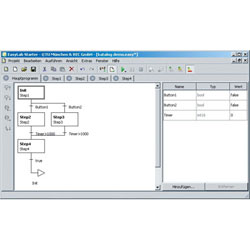 •Sequncer
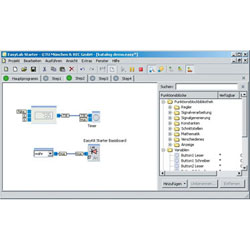 •Data Flow
can be used directly in EasyLab, thus providing a convenient way to solve programming problems.
Sequencer and data flow
EasyLab offers both of these options. The main program is a sequencer which allows branches and parallel sequences in addition to a linear sequence. Each step is assigned a data flow program as a subroutine. Programs are put together using functional modules with a high abstraction level. This means that the range of modules which can address the input and output channels of the microcontroller goes beyond functional modules alone, going from timers, counters, arithmetic and logical functions right up to entire controllers.
Simulation mode
Once the program has been created, it can be tested in simulation mode without any hardware connected. In this mode the user can assign the output values of input modules manually, as these cannot transmit values when no hardware is connected.
Automatic code generation
At the touch of a button, EasyLab generates C-code and then machine code from the program the user has created. This can then be transmitted to the microcontroller via the USB interface.
Live debugging
If required, EasyLab can install a monitor program on the microcontroller in addition to the main program. This makes it easy to monitor the program as it is running, as all the functional values are displayed in real-time in EasyLab. The user can see which subroutine is currently being executed and which values apply at the edges of the subroutine. This guarantees step-by-step commissioning and convenient, fast fault finding.
All the properties of EasyLab make it incredibly easy to create and commission even the most complex of applications (e.g. controllers).
Of course, it is also still possible to program EasyKit using C++.
Scope of delivery
•Starter board with powerful Cortex™-M3 microcontroller and two slots for EasyKit expansion modules
•2 EasyKit expansion modules: 1 DIO1, 1 AIO1
•EasyKit application board with DC motor, infrared light barrier for measuring motor speed, photoreceptor
•Programming software EasyLab as classroom licence with simulation capability
•USB connecting cable, stranded wire, screwdriver
•Detailed training documents in PDF format on CD
•Supplied in the practical Mini-Systainer
Technical data for processor board
•Processor with ARM® Cortex™-M3 core (STM32), 8 MHz clock frequency, 64 KByte Flash RAM
•External communication via USB 2.0
•Power supply via USB or external power supply unit
•3 pushbuttons and 3 LEDs
•2x 16-pin terminal strips for analogue and digital inputs and outputs
•2 slots for input/output modules
•Up to 4 digital inputs
•Up to 4 digital outputs
•Up to 4 analogue inputs
•Up to 4 analogue outputs
Expansion modules
EasyKit is a versatile, expandable system which can be adapted to your individual needs using additional input/output modules.
Please note: The modules can be plugged into either of the two sockets. However, only one module of the same type may be plugged into each socket.
Recommended accessories
•Input/output module AIO1 (V1.1)
•Input/output module AIO2 (V1.1)
•Input/output module DIO1 (V1.1)
•Input/output module DIO2 (V1.1)
•Input/output module ILT1 (V1.0)
•Input/output module ILT2 (V1.0)
Sequencer and data flow
EasyLab offers both of these options. The main program is a sequencer which allows branches and parallel sequences in addition to a linear sequence. Each step is assigned a data flow program as a subroutine. Programs are put together using functional modules with a high abstraction level. This means that the range of modules which can address the input and output channels of the microcontroller goes beyond functional modules alone, going from timers, counters, arithmetic and logical functions right up to entire controllers.
Simulation mode
Once the program has been created, it can be tested in simulation mode without any hardware connected. In this mode the user can assign the output values of input modules manually, as these cannot transmit values when no hardware is connected.
Automatic code generation
At the touch of a button, EasyLab generates C-code and then machine code from the program the user has created. This can then be transmitted to the microcontroller via the USB interface.
Live debugging
If required, EasyLab can install a monitor program on the microcontroller in addition to the main program. This makes it easy to monitor the program as it is running, as all the functional values are displayed in real-time in EasyLab. The user can see which subroutine is currently being executed and which values apply at the edges of the subroutine. This guarantees step-by-step commissioning and convenient, fast fault finding.
All the properties of EasyLab make it incredibly easy to create and commission even the most complex of applications (e.g. controllers).
Of course, it is also still possible to program EasyKit using C++.
Scope of delivery
•Starter board with powerful Cortex™-M3 microcontroller and two slots for EasyKit expansion modules
•2 EasyKit expansion modules: 1 DIO1, 1 AIO1
•EasyKit application board with DC motor, infrared light barrier for measuring motor speed, photoreceptor
•Programming software EasyLab as classroom licence with simulation capability
•USB connecting cable, stranded wire, screwdriver
•Detailed training documents in PDF format on CD
•Supplied in the practical Mini-Systainer
Technical data for processor board
•Processor with ARM® Cortex™-M3 core (STM32), 8 MHz clock frequency, 64 KByte Flash RAM
•External communication via USB 2.0
•Power supply via USB or external power supply unit
•3 pushbuttons and 3 LEDs
•2x 16-pin terminal strips for analogue and digital inputs and outputs
•2 slots for input/output modules
•Up to 4 digital inputs
•Up to 4 digital outputs
•Up to 4 analogue inputs
•Up to 4 analogue outputs
Expansion modules
EasyKit is a versatile, expandable system which can be adapted to your individual needs using additional input/output modules.
Please note: The modules can be plugged into either of the two sockets. However, only one module of the same type may be plugged into each socket.
Recommended accessories
•Input/output module AIO1 (V1.1)
•Input/output module AIO2 (V1.1)
•Input/output module DIO1 (V1.1)
•Input/output module DIO2 (V1.1)
•Input/output module ILT1 (V1.0)
•Input/output module ILT2 (V1.0)